|
 
Chang
Jiang
|
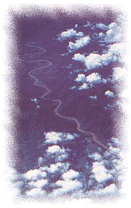
an
Aerial View
|
Coursing
over a distance of 6,380 kilometers, the mighty Chang Jiang, meaning "Long
River",
is the longest river in China
and Asia and the third longest in the world after the Amazon in South
America and the Nile in Africa.
Also called the Yangtze River, it is like the Huang
He
in that it is a cradle of the ancient Chinese people.
The
Yangtze, arising in Tibet
in the glaciers and snow-covered mountains of the "Roof of the World",
the Qinghai-Tibetan Plateau, and fed by hundreds of tributaries,
wanders eastward across the mainland of China.
It makes an incessant rush to Shanghai
and empities into the East
China Sea. The enormous
and inexhaustible hydroelectric resources of the Yangtze, producing no
waste gases, no waste water, nor waste residues, is superior to
oilfields and coalfields and therefore is considered the "King" of all
energies capable of generating huge profits with a minimum input. From
its source to its estuary, the Yangtze River
meanders over 6,300 kilometers. Its annual runoff is up to 268 million
kilometers.
Passing
many of the large and important cities of China,
the river has been an important trade and transportation route since
ancient times. The major cities through which the Yangtze
River
flows are (east to west):
|

a
Yangtze River
Bridge
|
Jiangjin,
Chongqing,
Peiling, Zigui, Jiangling, Yueyang, Wuhan,
Anqing, Wuhu,
Nanjing,
Zhenjiang,
and Shanghai.
In addition, along the River, one feels merged with nature and will
have a chance to explore the mysterious ancient country of China
in the Orient and to learn the life of country people.
Natural
secenery and landscapes along the River are beautiful with many
historical and cultural cities and towns, including Suzhou
and Hangzhou.
There is a saying that goes: "The best place in the heavens is
paradise; the best place on the earth is Suzhou-Hangzhou." Other places
the river goes through are: Tai
Lake;
Naning, once the ancient capitals of China
as well as the political and cultural center in the Southeast; Mount
Lu,
a summer resort; and Wuhan.
Sanxia,
the Three Gorges, and other Natural Sites
The most impressive section of the river are the three Yangtze River
gorges: the Qutang Gorge, the Wuxia Gorge, and Xiling Gorge,
collectively known as Sanxia, or the Three Gorges.
|

San
Xia
|
With
Baidi
City,
Fengjie in the Sichuan
province to the west end, and Nanjin Pass of Yichang in the Hubei
province at the east, the Three Gorges, Qutang, Wu and Xiling, total
192 kilometers in length.
Wu
Gorge, 44 kilometers long, is known for its deep valleys and quiet
beauty. The "Twelve
Peaks"
lining the banks of Wu Gorge have been admired by visitors from all
over the world. Among the twelve peaks at the Wu Gorge, the Goddess
Peak
is the most exquisite. It is said that if you look carefully, a
silhouette of a goddess can be seen at the top of Goddess
Peak,
and hence its name.
Qutang
Gorge, known for its magnificence, is only 8 kilometers long with many
scenic spots. These include the Meng Liang Staircase, the Ancient Plank Road,
the Kui Gate, the Seven
Gate
Cave,
the Bellows Gorges, and the Rhinoceros Watching the Moon.
|
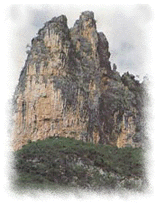
San
Xia Close-up
|
Xiling
Gorge, extending 66 kilometers in length and full of turbulent currents
and whirlpools, is one of the most dangerous shoals. It is composed of
many scenic spots, such as "Military Manual and Precious Sword Gorge",
"Ox's Live and Horse's Lung Gorge", "Kongling Shoal", and "Shadow-Play
Gorge". Among the cultural relics in the gorge are "Huangling
Temple"
and the "Three
Travellers
Cave".
The
Lesser Three Gorges, referring to the three separate valleys of the Daning
River,
are respectively called "Dragon-Gate Gorge", "Misty Gorge", and
"Emerald Gorge". With clear water flowing fast through the gorges and
precipices and peaks towering to the sky, one can take a small boat to
enjoy these extremely marvellous spectacles of nature.
The
Red Cliff is situated in the middle reaches of the Yangtze River, about
38 kilometers from the northwest of Puqi
City.
It is an important scenic spot of the ancient Three
Kingdoms
and Three Gorges.
|

Shennong
Stream
|
The
Red Cliff includes three parts - Chibi Hill, Nanpin Hill, and Jinluan
Hill. The Chibi Hill faces the Yangtze river
in the north, and the two characters "Chibi" (Red Cliff) are clearly
carved in it. At the top of the hill stand the "Yijiang Pavilion" and a
huge stone statue of Zhou Yu, chief commander of Wu State. On the east
side of the hill stands the Museum of the Red Cliff Battle which is the
first museum based on ancient battles in China.
The
60-kilometer Shennong Stream rises in the southern part of the
Shennongjia Reserve. The stream flows north to south through deep
gorges and finally merges with the Yangtze at the mouth of the Wu
Gorge. The crystal clear and unpolluted water flows very swiftly, and a
tour by Sampan will give you an idea of just how powerful the current
is in this rapid stream. The Shennong Stream is indeed a very
attractive scenic spot.
|

